Table of Contents
ToggleThe flat beater, commonly called the paddle attachment, is the workhorse of any KitchenAid stand mixer. It’s the tool most home bakers reach for first, yet many don’t fully understand when to use it, how to care for it, or what options exist beyond the standard model. Whether someone’s creaming butter and sugar for cookies, mixing cake batter, or mashing potatoes, the paddle attachment does the heavy lifting. But using the wrong attachment or neglecting maintenance can lead to uneven mixing, wear on the mixer, or even breakage. This guide walks through everything a home cook needs to know about the KitchenAid paddle mixer attachment, from basic operation to troubleshooting common issues, so every recipe turns out right.
Key Takeaways
- The KitchenAid mixer paddle attachment uses planetary motion to blend ingredients evenly without overworking them, making it ideal for cake batters, cookie doughs, frostings, and mashed vegetables.
- Understanding when to use the paddle versus the wire whip and dough hook prevents motor strain and ensures better texture in finished recipes—the paddle works best for medium-density mixtures, not heavy bread doughs or whipped toppings.
- Proper attachment involves aligning the paddle’s flat notch with the hub’s pin, then rotating counterclockwise about a quarter turn until it locks with a click, followed by a gentle tug to confirm security.
- Hand wash coated flat beaters immediately after use to prevent nylon coating damage, while stainless steel and Flex Edge beaters require special care—never use the dishwasher for Flex Edge models since the silicone wing can degrade in high heat.
- Maintain ideal beater-to-bowl clearance at about 1/8 inch using the mixer’s adjustment screw to prevent scraping and uneven mixing; a dime should fit between the paddle and bowl bottom.
- Address common issues like chipping coating, misaligned clearance, or wobbling early to extend the life of your paddle attachment and avoid costlier repairs or replacements.
What Is a KitchenAid Mixer Paddle Attachment and How Does It Work?
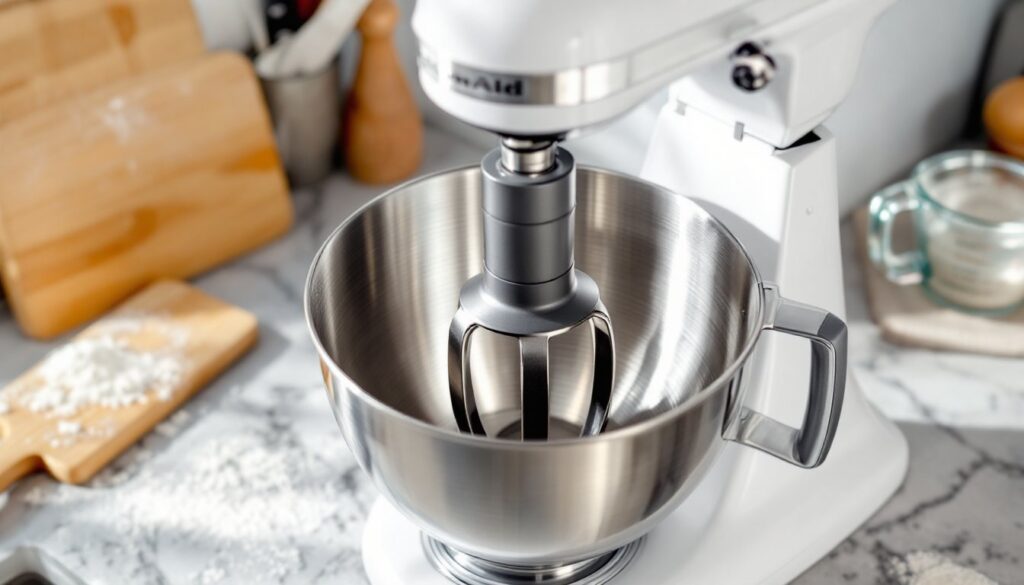
The paddle attachment (also called a flat beater) is a broad, flat mixing tool with a curved blade designed to scrape the sides and bottom of the mixing bowl while blending ingredients. Unlike the wire whip, which incorporates air, or the dough hook, which kneads, the paddle combines ingredients thoroughly without overworking them.
Most KitchenAid mixers ship with a coated or stainless steel paddle. The flat edge sits close to the bowl’s contour, typically within 1/8 inch, to ensure consistent mixing without scraping metal on metal. As the mixer head spins, the paddle rotates around the bowl in a planetary motion, meaning the attachment itself spins while orbiting the bowl’s center. This action ensures even distribution and prevents pockets of unmixed flour or butter.
The paddle works best for medium-density mixtures: cake batters, cookie doughs, frostings, and mashed vegetables. It won’t incorporate enough air for meringues or whipped cream, and it’s not rigid enough to handle heavy bread doughs. For those tasks, the whip and dough hook are better suited. Understanding this distinction prevents motor strain and delivers better texture in finished recipes.
When to Use the Paddle Attachment vs. Other Mixer Attachments
Choosing the right attachment makes the difference between fluffy frosting and overbeaten soup. Here’s when to grab the paddle:
Use the paddle attachment for:
- Creaming butter and sugar – The paddle beats fat and sugar together, creating air pockets that make cookies and cakes tender.
- Mixing cake and quick bread batters – It blends wet and dry ingredients without developing too much gluten, which would make baked goods tough.
- Mashing potatoes or root vegetables – The flat blade breaks down cooked vegetables into a smooth consistency.
- Making frostings and icings – Buttercream, cream cheese frosting, and royal icing all benefit from the paddle’s thorough blending.
- Combining meat mixtures – Meatloaf, meatballs, and sausage blends mix evenly without overworking the proteins.
When to switch attachments:
- Wire whip: For whipping cream, beating egg whites, or making meringues. The open wires incorporate maximum air.
- Dough hook: For yeast breads, pizza dough, and bagels. The hook kneads gluten strands without overheating the dough.
- Flex Edge beater: A paddle with a built-in silicone scraper that hugs the bowl’s edge. It’s ideal for thick batters and sticky mixtures, though not included with most base models.
Many home bakers rely on popular attachment guides when expanding their mixer toolkit beyond the basics. The paddle remains the default for most everyday mixing tasks, but knowing when to swap attachments prevents recipe failures and motor wear.
Types of Paddle Attachments Available for KitchenAid Mixers
KitchenAid and third-party manufacturers offer several paddle variations, each suited to specific tasks or mixer models.
Standard Flat Beater
The coated flat beater ships with most KitchenAid mixers. It has a white or gray nylon coating over metal, which protects the stainless steel bowl from scratches. The coating can chip over time, especially if run against the bowl at high speed or washed in a dishwasher. Once chipped, some bakers replace it to avoid coating flakes in food.
Burnished Flat Beater
The burnished (stainless steel) paddle is bare metal with no coating. It’s more durable and dishwasher-safe, but can scratch glass or ceramic bowls if the mixer isn’t properly adjusted. This version is standard on some professional-grade models and available as an upgrade for others.
Flex Edge Beater
The Flex Edge beater features a flexible silicone wing along one edge that continuously scrapes the bowl. It reduces the need to stop and manually scrape down sides, saving time when making thick batters or sticky doughs. But, the silicone can wear out or tear with heavy use, and it’s not dishwasher-safe. It’s sold separately and fits most tilt-head and bowl-lift models, but checking compatibility before purchase is essential.
Specialty and Vintage Paddles
Older KitchenAid models may use unique attachment hubs or slightly different paddle dimensions. Aftermarket sellers offer reproductions, but confirming the model number ensures proper fit. Some specialty paddles, like those with multiple blades or European-style designs, promise faster mixing but often don’t outperform the standard beater for home use.
When selecting a replacement or upgrade, consider the mixer model, bowl material, and typical recipes. A baker making thick cookie dough weekly might find the Flex Edge worth the investment, while someone mostly making cake batter can stick with the standard coated version.
How to Properly Attach and Remove Your Paddle Attachment
Attaching the paddle correctly prevents wobbling, uneven mixing, and potential damage to the mixer’s attachment hub. The process is straightforward but requires attention to alignment.
To attach the paddle:
- Unplug the mixer or ensure it’s switched off. This prevents accidental startup.
- Tilt the mixer head back (on tilt-head models) or lower the bowl (on bowl-lift models) to access the attachment hub.
- Align the paddle’s shaft with the attachment hub on the mixer head. The shaft has a flat notch that fits a corresponding pin inside the hub.
- Slide the paddle up onto the hub until it stops, then rotate it counterclockwise (to the left) about a quarter turn. The paddle should lock into place with a slight click.
- Tug gently to confirm it’s secure. A properly attached paddle won’t slide off or wiggle excessively.
To remove the paddle:
- Turn the mixer off and unplug it.
- Rotate the paddle clockwise (to the right) about a quarter turn to unlock it from the hub.
- Pull down firmly to release it from the shaft.
If the paddle feels stuck, check for dried batter or dough residue around the hub. A damp cloth can clean the area, and a small amount of food-safe lubricant on the shaft (not inside the hub) can ease stubborn attachments. Never force the paddle, excessive pressure can strip the locking mechanism or crack the attachment shaft.
After attaching, run the mixer briefly on low speed (without ingredients) to confirm the paddle rotates smoothly and doesn’t scrape the bowl. Adjust the beater-to-bowl clearance if needed, following the mixer’s manual for specific adjustment instructions. Most models have a screw on the motor head that raises or lowers the attachment height.
Cleaning and Maintenance Tips for Long-Lasting Performance
Proper care extends the life of the paddle attachment and keeps it mixing efficiently. Neglecting cleanup can lead to buildup, coating damage, or even rust on metal components.
Cleaning the paddle:
- Hand wash coated paddles in warm, soapy water immediately after use. The dishwasher’s heat and harsh detergents can crack or peel the nylon coating. Use a soft sponge, abrasive scrubbers accelerate wear.
- Dishwasher-safe stainless paddles can go in the dishwasher, but hand washing prevents water spots and extends the finish’s shine.
- Flex Edge beaters should always be hand washed. The silicone wing can degrade in high heat, and food particles can lodge between the wing and the paddle body.
- Dry thoroughly before storing. Water trapped in crevices, especially around the attachment shaft, can cause rust or mineral deposits.
Maintaining performance:
- Inspect the coating regularly on standard flat beaters. Small chips are cosmetic, but large flakes can contaminate food. Replace if coating loss is extensive.
- Check the silicone edge on Flex Edge beaters for tears or separation. A damaged wing won’t scrape effectively and may shed particles into the mixture.
- Lubricate the attachment hub sparingly if the paddle sticks during installation. A tiny dab of food-grade mineral oil on the shaft (not in the hub) can help, but excess lubricant attracts dust and grime.
- Store paddles in a dry place, preferably hanging or in a drawer organizer. Tossing them loose in a drawer can bend the blade or damage the shaft.
Organizing kitchen tools and attachments efficiently is a common topic on sites like The Kitchn, where proper storage tips help maintain equipment longevity. For the paddle, avoiding moisture and impact keeps it ready for the next batch of cookies or frosting.
Common Problems and Troubleshooting Solutions
Even well-maintained paddles can encounter issues. Here’s how to diagnose and fix the most common problems.
Paddle scrapes the bottom or sides of the bowl:
This indicates incorrect beater-to-bowl clearance. Most KitchenAid mixers have an adjustment screw on the motor head (often covered by a small cap). Turn the screw slightly counterclockwise to raise the paddle. The ideal clearance is about 1/8 inch, close enough to scrape efficiently without metal-on-metal contact. Test by placing a dime between the paddle and bowl bottom: it should just fit.
Paddle doesn’t lock onto the hub:
Cake batter or dough residue can gum up the locking mechanism. Clean the attachment hub and the paddle shaft with a damp cloth, then dry completely. If the paddle still won’t lock, inspect the shaft for cracks or wear on the locking pin. Replacement may be necessary.
Coating is chipping or peeling:
This is normal wear over time, especially if the paddle has been through the dishwasher or used at high speeds. Small chips are harmless, but if large pieces flake off, replace the paddle to avoid contaminating food. Switching to a stainless steel paddle prevents this issue entirely.
Ingredients aren’t mixing evenly:
Check that the paddle is fully locked in place and the mixer speed is appropriate. Start on low (speed 1 or 2) to combine dry ingredients, then increase to medium (speed 4 or 6) for creaming or blending. If the paddle is too high above the bowl, it won’t reach all the ingredients, adjust clearance as described above.
Paddle wobbles or vibrates during use:
A bent paddle or worn attachment hub can cause wobbling. Lay the paddle flat on a counter to check for bends. If the blade isn’t flat, gentle pressure may straighten minor warps, but severe damage requires replacement. A worn hub may need professional service, contact KitchenAid support for repair options.
Home improvement and appliance maintenance are frequently covered on platforms like The Spruce, where troubleshooting guides help DIYers extend the life of household tools. For mixer attachments, addressing small issues early prevents costlier repairs or replacements down the line.
Conclusion
The KitchenAid paddle attachment is a simple tool, but using it correctly makes a measurable difference in baking and cooking results. Knowing when to choose the paddle over the whip or dough hook, how to attach it securely, and how to maintain it ensures consistent performance and protects the mixer itself. Whether creaming butter for cookies or mixing frosting for a cake, the paddle attachment handles everyday mixing tasks efficiently, when it’s properly cared for and adjusted. With the right practices, a single paddle can last through thousands of batches, making it one of the best investments in any home kitchen.