Table of Contents
TogglePressure washing is one of those rare side hustles that requires minimal certification, modest upfront investment, and delivers immediate visible results clients actually notice. In 2026, property values keep climbing, and homeowners are spending more on exterior maintenance than ever before. Whether someone’s looking to supplement their income on weekends or build a full-time business, pressure washing offers a straightforward path, if they know where to find clients and how to position themselves. This guide walks through the practical steps to land those first jobs, build momentum, and turn occasional gigs into steady work.
Key Takeaways
- Start a pressure washing business with minimal upfront costs under $400 and no state licensing required in most areas, making it an accessible side hustle with 60–70% profit margins.
- To get pressure washing jobs, claim a Google Business Profile immediately, build a simple website with local keywords, and post before-and-after photos on social media weekly.
- Your first clients come from personal networks, door-to-door canvassing in neighborhoods with visible grime, and offering seasonal promotions like spring driveway specials.
- Ask for referrals after every completed job and create a referral incentive program offering $25 off to existing clients for new customer referrals.
- Price residential driveways at $100–$300 using a per-square-foot model ($0.08–$0.20/sq ft) or flat rates, and set a minimum charge of $125–$150 to cover travel and setup costs.
- Partner with real estate agents, property managers, and complementary trades like landscapers and painters to generate steady referrals and expand your service offerings.
Why Pressure Washing Is a Lucrative Opportunity Right Now
The barrier to entry is low. Unlike plumbing or electrical work, pressure washing doesn’t require state licensing in most jurisdictions (though business licenses and liability insurance are essential). A homeowner can start with a consumer-grade gas pressure washer in the 2,800–3,200 PSI range for under $400, and many first-time operators get their initial clients before upgrading to commercial equipment.
Demand is consistent and seasonal peaks are predictable. Spring cleaning, pre-sale home prep, and fall deck maintenance drive steady bookings. Driveways, siding, fences, and concrete patios accumulate grime year-round, and most property owners lack the equipment or time to tackle it themselves.
Profit margins can be healthy. After deducting fuel, chemicals, and equipment wear, experienced operators report gross margins of 60–70% on residential jobs. A typical driveway cleaning might take 1.5–2 hours and command $150–$250 depending on size and region. That’s competitive hourly income for work that doesn’t require a four-year degree.
Scalability is straightforward. Once someone’s booked solid, they can hire a helper, add a second rig, or expand into commercial contracts (storefront cleaning, fleet washing, parking lot maintenance). The business model scales without dramatic overhead increases.
Essential Equipment and Setup to Start Landing Jobs
A reliable pressure washer is the foundation. For residential work, a gas-powered unit with at least 3,000 PSI and 2.5 GPM handles most tasks, driveways, siding, decks, fences. Electric models work for light-duty jobs but lack the flow rate and portability for serious client work. Commercial-grade units (Honda or Kohler engines, triplex pumps) cost $1,200–$2,500 but last longer and perform better under daily use.
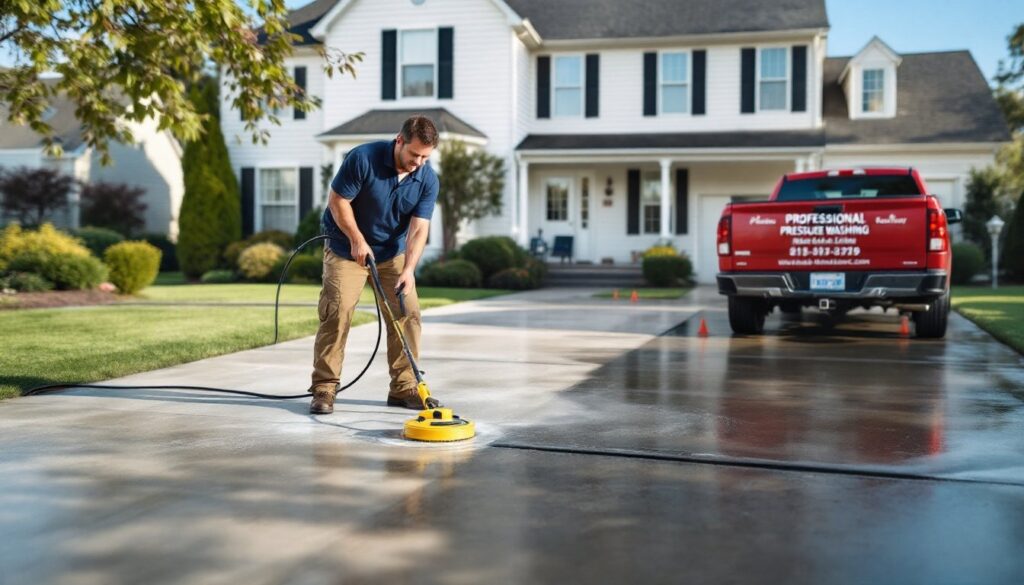
Nozzle tips matter. A standard set includes 0° (red), 15° (yellow), 25° (green), 40° (white), and a soap nozzle (black). The 0° tip is aggressive, use it sparingly and never on wood or siding. The 25° and 40° tips handle most residential surfaces safely. Surface cleaners (round attachments with rotating nozzles) speed up flatwork like driveways and patios dramatically and deliver more even results than a wand alone.
Chemicals and surfactants boost results. Sodium hypochlorite (pool-grade bleach diluted to 1–3%) removes mold, mildew, and organic stains from siding and fences. Degreasers tackle oil spots on concrete. Always apply chemicals at low pressure using a downstream injector or pump sprayer, let them dwell for 5–10 minutes, then rinse at higher pressure. Wear chemical-resistant gloves, safety goggles, and closed-toe boots when handling concentrates.
Liability insurance is non-negotiable. A single slip-and-fall claim or damaged siding can wipe out months of profit. General liability policies for pressure washing typically run $400–$800 annually for $1–2 million in coverage. Many clients, especially commercial accounts, won’t hire without proof of insurance.
Transportation and water access round out the basics. A pickup truck or trailer hauls equipment reliably. Some operators carry a 50-gallon water tank for remote jobs, though most residential clients provide a hose bib. Bring extra hoses (50–100 feet) to reach all sides of a property without moving the rig.
Build Your Local Presence and Online Visibility
Claim and optimize a Google Business Profile immediately. This free listing appears in local map searches when homeowners type “pressure washing near me.” Include accurate service hours, a phone number, service area radius, and high-resolution before-and-after photos. Encourage satisfied customers to leave reviews, five-star ratings boost visibility and conversion.
A simple website establishes credibility. It doesn’t need to be fancy. A single-page site with services offered, service area, contact form, and a gallery of completed jobs works. Mention specific services: driveway cleaning, house washing, deck restoration, fence cleaning, concrete sealing. Use city and neighborhood names in headings and text to capture local search traffic. Hosting costs around $10–15/month: template builders like Squarespace or Wix simplify setup.
Social media provides free exposure and social proof. Post before-and-after photos on Facebook and Instagram weekly. Tag the city or neighborhood. Use hashtags like #PressureWashing, #ExteriorCleaning, and #[YourCity]HomeServices. Join local Facebook groups (neighborhood groups, homeowner associations, buy/sell/trade pages) and engage genuinely, answer questions, share seasonal tips. Most groups allow service providers to post occasionally if they’re active contributors.
List the business on platforms like Angi and similar home service directories. These sites connect homeowners with local contractors and often rank well in search results, funneling leads to operators who maintain updated profiles and gather positive reviews.
Proven Strategies to Find Your First Clients
Start with personal network and immediate geography. Text friends, family, neighbors, and coworkers offering an introductory discount (e.g., 20% off first job). Many first clients come from this circle, and each completed job generates referrals and photos for marketing.
Door-to-door canvassing still works in residential neighborhoods. Walk a street, knock on doors in the early evening (5–7 PM when people are home), and offer a free estimate. Bring a tablet or phone to show before-and-after images. Focus on homes with visible grime, dirty driveways, stained siding, algae on fences. Leave a door hanger or business card if no one’s home.
Yard signs and vehicle magnets turn every job into advertising. A simple 18″ × 24″ coroplast sign staked in the front yard during a job costs under $20 and catches the attention of neighbors. Magnetic door signs on the truck reinforce brand visibility while driving between jobs.
Offer seasonal promotions to create urgency. “Spring driveway special, $149 for standard two-car driveway” or “Book this week, get fence cleaning 25% off.” Post these on social media, in local groups, and on the website. Time-limited offers push hesitant homeowners to commit.
Partner with real estate agents and property managers. Realtors preparing homes for sale need exteriors cleaned before listing photos. Property managers oversee rentals and HOA common areas that require regular maintenance. Introduce yourself, offer a referral fee (10–15% is common), and provide business cards they can hand to clients. Platforms like HomeAdvisor also connect service providers with homeowners actively seeking estimates, though lead fees apply.
Networking and Word-of-Mouth Tactics That Work
Ask for referrals immediately after completing a job. While packing up equipment, say: “If you’re happy with the results, I’d appreciate it if you’d mention me to your neighbors or leave a quick review on Google.” Make it easy, send a follow-up text with a direct link to the Google review page.
Join local business networking groups. Chambers of commerce, BNI chapters, and morning coffee meetups connect service providers with potential clients and referral partners. Attend consistently, give brief introductions, and offer value (e.g., free pressure washing demos at community events). Other members, landscapers, painters, roofers, can become referral sources when their clients need complementary services.
Cross-promote with related trades. Landscapers, deck builders, painters, and window cleaners serve the same homeowner base. Offer to refer clients to them in exchange for reciprocal referrals. Some operators bundle services (e.g., pressure washing + gutter cleaning) with a partner and split the revenue.
Create a simple referral incentive program. Offer existing clients $25 off their next service for every new customer they refer who books a job. Track referrals carefully and honor the discount promptly, word spreads when businesses keep their promises.
Volunteer services strategically. Offer to clean a local nonprofit’s building, a church entryway, or a community center patio at cost or free. Document the work with photos and share on social media. The goodwill and visibility often lead to paying clients, and some operators mention community involvement when bidding commercial contracts.
Pricing Your Services to Win Jobs and Stay Profitable
Understand regional pricing ranges. Rates vary by market, competition, and cost of living. In most U.S. metro areas, residential driveways run $100–$300, house washing $200–$600, and decks $150–$400 depending on size and condition. Research competitors’ pricing by calling for estimates or checking online listings. Resources like ImproveNet publish average cost data by project type and region.
Price by square footage or flat rate depending on the job. Flatwork (driveways, patios, sidewalks) is easiest to price per square foot, typical rates range $0.08–$0.20/sq ft. Measure or estimate area (standard two-car driveway ≈ 600 sq ft). Vertical surfaces (siding, fences) can also be priced per square foot ($0.10–$0.30/sq ft), though many operators quote flat rates after a walkthrough to account for obstacles, trim, landscaping, and difficulty.
Factor in travel time and setup. Jobs under $100 often aren’t worth the trip once fuel, equipment wear, and time are considered. Set a minimum charge, many operators use $125–$150, to cover showing up, unloading, and basic setup.
Offer tiered packages to upsell. A basic driveway clean, a mid-tier package that adds walkways and patio, and a premium package including driveway, walkways, patio, and house wash give clients options and increase average ticket size. Bundling services often justifies a discount (e.g., 10% off when booking multiple areas) while still boosting total revenue.
Be transparent about add-ons and variables. Heavily stained concrete might require a second pass or chemical pre-treatment, communicate that upfront. If a client’s water pressure is weak or their hose bib is far from the work area, mention potential delays or extra charges before starting.
Adjust pricing as experience and demand grow. New operators often underprice to build a portfolio and reviews. Once booked consistently, raise rates incrementally (5–10% every few months) until pushback occurs. Premium pricing paired with excellent service and fast turnaround often attracts higher-quality clients who value reliability over bargain hunting.
Conclusion
Landing pressure washing jobs comes down to visibility, reliability, and delivering results that make clients want to brag to their neighbors. Start with the basics, solid equipment, proper insurance, and a professional online presence. Then hustle: knock doors, post before-and-afters, ask for referrals, and network with trades that serve the same homeowners. Price competitively at first, then adjust as demand builds. Most importantly, show up on time, communicate clearly, and leave every driveway, deck, and fence looking dramatically better than when you arrived.