Table of Contents
ToggleAnts marching across your kitchen counter or trailing along your baseboards aren’t just annoying, they’re a sign you need the right control product, and fast. The ant control market has evolved dramatically, offering everything from slow-acting baits to instant-kill sprays, outdoor barriers, and eco-friendly alternatives. But here’s the catch: grabbing the wrong product wastes time and money while the colony keeps growing. This guide breaks down every major category of ant control products, how they actually work, and which type matches your specific ant problem so you can stop the invasion efficiently.
Key Takeaways
- Ant control products fall into four main categories—baits, sprays, granules, and natural alternatives—each designed for different infestation levels and situations.
- Ant baits are the most effective for eliminating entire colonies because worker ants carry slow-acting poison back to the nest and queen over 7-14 days.
- Sprays deliver immediate results for visible ants and create residual barriers lasting 24-90 days, making them ideal for combining with baits for complete control.
- Outdoor perimeter treatments using granules or liquid sprays applied every 60-90 days prevent ant entry and control yard nesting colonies before they invade your home.
- Matching ant control products to your specific ant species, infestation size, and location—plus layering multiple solutions—ensures efficient elimination rather than wasting time and money on the wrong product.
- Professional pest control is worth considering for structural carpenter ant infestations, pharaoh ants in apartments, or fire ant yards with 20+ mounds that resist DIY approaches.
Understanding Different Types of Ant Control Products
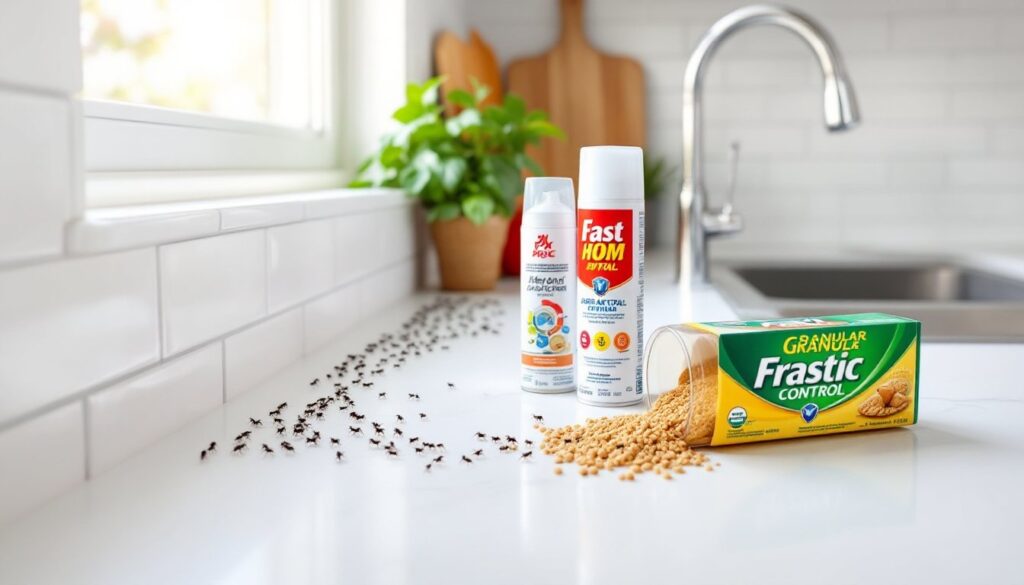
Ant control products fall into four main categories, each engineered for different situations and infestation levels. Baits use slow-acting poison that worker ants carry back to the colony, targeting the queen and nest. Sprays and liquid treatments deliver contact kill for visible ants and create residual barriers. Granular products establish outdoor perimeters and treat lawns or garden beds. Natural alternatives use plant-based ingredients or physical barriers for households prioritizing pet safety or organic solutions.
The key difference lies in speed versus thoroughness. Contact killers work in minutes but only eliminate ants you can see. Baits take days or weeks but can wipe out entire colonies, including the thousands you don’t see. Outdoor treatments prevent entry, while indoor products handle active infestations.
Most effective ant control strategies combine multiple product types, perimeter granules outside, baits near entry points, and spot sprays for immediate cleanup. Understanding how each category functions helps homeowners build a layered defense instead of relying on a single solution that might not match the problem.
Ant Baits: How They Work and When to Use Them
Ant baits contain food attractants mixed with slow-acting insecticides like borax, fipronil, or hydramethylnon. Worker ants consume the bait and carry it back to the nest, spreading poison throughout the colony via trophallaxis (food sharing). The delay is intentional, ants need 24-72 hours to distribute the toxin before dying, ensuring it reaches the queen.
Liquid bait stations work best for sugar-feeding ants like Argentine ants, odorous house ants, and pharaoh ants. Place stations along trails, near water sources, and where you’ve spotted activity, not randomly around the room. Gel baits offer precision application in cracks, behind appliances, and along baseboards. Solid bait stations suit protein-seeking ants like carpenter ants, though you may need to switch bait types seasonally as ant dietary preferences change.
Patience is critical. You’ll see more ants initially as workers swarm the bait, don’t panic and spray them. That defeats the purpose. Most baits take 7-14 days to collapse a colony. Replace dried-out gel every few days and monitor stations weekly. If ants ignore your bait after 48 hours, they’re likely feeding on protein instead of sugar (or vice versa), so switch formulas.
Baits excel at eliminating hidden nests inside walls or under slabs where sprays can’t reach. They’re the gold standard for pharaoh ants and other species that “bud” into multiple colonies when sprayed. But, they won’t stop a trailing line of ants right now, that’s where sprays come in.
Sprays and Liquid Treatments for Immediate Results
Contact sprays kill ants on touch using pyrethroids like bifenthrin, cypermethrin, or deltamethrin. Aerosol sprays deliver instant results for visible ants but offer minimal residual protection, usually 24-48 hours on porous surfaces. Residual liquid concentrates, mixed with water and applied via pump sprayer, create barriers lasting 30-90 days on non-porous surfaces like baseboards, door frames, and foundation perimeters.
For indoor spot treatment, ready-to-use (RTU) spray bottles work fine for occasional scouts. Mixing your own solution from concentrate like Talstar P or Suspend SC costs less per application and lets you treat larger areas, baseboard perimeters, window sills, and behind appliances. Apply a continuous 4-inch band where walls meet floors, focusing on entry points. Don’t soak surfaces: a light, uniform coating does the job.
Outdoor foundation sprays create a chemical barrier ants cross and die or avoid entirely. Treat a 3-foot band up the foundation and 3 feet out onto the ground. Reapply after heavy rain, as moisture degrades pyrethroids. Many homeowners following seasonal maintenance schedules include perimeter spraying every 60-90 days during warm months.
Safety note: Pyrethroids are toxic to cats and aquatic life before drying. Keep pets off treated surfaces for 1-2 hours, and never spray near ponds, drains, or storm sewers. Wear nitrile gloves and eye protection when mixing concentrates. Read the label, application rates and surface restrictions vary by product and active ingredient concentration.
Granular and Outdoor Perimeter Control Solutions
Granular ant controls are slow-release insecticides applied to lawns, mulch beds, and soil around foundations. Products containing bifenthrin, lambda-cyhalothrin, or carbaryl bind to soil particles and activate when moisture releases the active ingredient. This creates a treatment zone lasting 2-4 months, killing ants that forage or nest in treated areas.
Application is straightforward: use a broadcast spreader for large lawns or a handheld spreader for targeted treatment. Apply at manufacturer-specified rates (typically 2-4 lbs per 1,000 sq ft) and water in lightly, 0.25-0.5 inches of irrigation helps bind granules to soil and activate the insecticide. Don’t apply before heavy rain, which can wash product into storm drains.
Granules shine for controlling fire ants, pavement ants, and large carpenter ant colonies nesting in landscape timbers or mulch. They’re less effective on hard surfaces like concrete patios or asphalt, use liquid sprays there instead. Combination products like Ortho BugClear include both fast-acting contact kill and extended residual, covering immediate and long-term control.
For fire ant mounds, use two-step treatment: broadcast granules across the yard, then apply individual mound treatments with products containing acephate or hydramethylnon. This method, recommended by university extension services, controls both visible and satellite colonies.
Application tip: Store granular products in airtight containers. Moisture clumps granules and deactivates ingredients. Always wear dust masks when broadcasting, inhaling insecticide dust irritates lungs and isn’t worth the shortcut of skipping PPE.
Natural and Pet-Safe Ant Control Alternatives
Natural ant controls use plant-derived ingredients, desiccants, or physical barriers instead of synthetic pyrethroids or neonicotinoids. Diatomaceous earth (DE), a powdered sedimentary rock, damages ant exoskeletons and causes dehydration. Apply food-grade DE in a thin layer along baseboards, behind appliances, and around entry points. It works indefinitely until wet, but moisture deactivates it. Reapply after mopping or humidity spikes.
Borax-based baits (like Terro Liquid Ant Baits) are technically natural, borax is a mined mineral. They’re slower than synthetic baits but highly effective against sugar ants and generally safer around pets if stations remain sealed. Still, don’t let dogs chew bait stations: concentrated borax causes stomach upset.
Essential oil sprays containing peppermint, clove, or eugenol repel ants and kill on contact but offer zero residual. They’re best for organic gardening applications or households avoiding all synthetic chemicals. Reapplication is constant, every 24-48 hours for active infestations. These products from sources like home improvement retailers don’t eliminate colonies: they just redirect traffic.
Soap and water (1 tablespoon dish soap per quart water) kills ants via suffocation and wipes up pheromone trails. It’s a free, pet-safe solution for small problems but won’t touch nests.
Honestly, natural products work best for prevention and minor issues. A massive carpenter ant colony inside your wall studs or a fire ant yard infestation requires conventional chemistry. If you’ve got kids or pets and must use synthetics, apply baits inside childproof stations and spray perimeters when the family’s out for a few hours. That’s a reasonable middle ground.
Choosing the Right Product for Your Ant Problem
Match your product to the ant species, infestation size, and location. Small black ants trailing into kitchens respond well to liquid bait stations placed along their path. Carpenter ants, the big ones that tunnel through structural wood, need protein baits, perimeter sprays, and possibly pro treatment if they’re nesting in wall voids or joists. Fire ants require outdoor granular treatments: indoor baits won’t touch yard colonies.
For active indoor trails, combine baits (to kill the colony) with spot sprays (to clean up visible ants and disrupt pheromone trails). Spray first, then place baits 1-2 feet away so you don’t contaminate them with repellent sprays. Many effective ant control methods use this two-pronged approach.
Outdoor entry prevention calls for liquid foundation sprays or granules. Treat the perimeter every 60-90 days during ant season (spring through fall in most regions). If ants nest in your lawn, broadcast granules and water them in.
Pet and child safety considerations tip the scale toward bait stations with physical barriers or outdoor-only spray applications. Never apply granules to areas where kids play barefoot or pets graze, even “pet-safe” labels mean safe after watering in, not during application.
When to call a pro: Structural carpenter ant infestations (sawdust piles, rustling sounds in walls), pharaoh ants in apartments (they require building-wide treatment), or fire ant yards exceeding 20+ mounds justify professional help. Pest control operators have access to non-repellent insecticides and application equipment homeowners can’t buy. Sometimes the $150-300 service call beats months of DIY trial-and-error.
Conclusion
Effective ant control isn’t about buying the most expensive product, it’s about matching the right tool to the job. Baits eliminate colonies, sprays handle immediate cleanup and barriers, granules protect yards, and natural options fill the gap for low-toxicity households. Most successful strategies layer multiple products and give them time to work. Skip the guesswork, identify your ant species, assess the infestation scope, and deploy the appropriate combination. With the right approach, you’ll go from constant ant battles to long-term control.